

Introduction
Artificial Intelligence is moving from answering questions to taking action — calling tools, moving money, and completing tasks autonomously.
Rushabh's Agentic XDC Payments showed a powerful pattern: users type plain English, and an AI agent sends USDC on XDC Network without opening a wallet UI.
That demo answers one question:
"How do I pay a person on-chain?"
This project extends that idea to a second question:
"How does an AI agent pay for services on the internet — APIs, data, tools — without API keys, subscriptions, or signups?"
The answer is x402 — the HTTP 402 Payment Required standard for pay-per-use micropayments in USDC.
Instead of only sending USDC to a wallet address, the same agent can:
- Call a paid FX rate API
- Receive HTTP
402with the price - Pay USDC on XDC
- Retry the request with payment proof
- Return the result in plain English
No account. No API key. No monthly subscription. Just pay-per-call.
What the Project Does
This is an end-to-end MVP with three parts:
| Component | Role |
|---|---|
| React Chat UI | User asks in natural language |
AI Agent (Node.js) |
Parses intent, pays USDC, calls APIs |
FX API Server (Node.js) |
Serves exchange rates behind an x402 paywall |
Two agent skills — one wallet
| You say | What happens |
|---|---|
| "What's the GBP/USD rate?" | x402 flow: 402 → pay 0.1 USDC → retry → FX data |
| "Send 1 USDC to 0xB0EF…" | Direct USDC transfer (same as the original article) |
One XDC wallet. Two use cases. People and APIs.
Why x402? Why Not a Normal HTTP API?
Most APIs today work like this:
- Sign up on the provider's website
- Add a credit card or buy credits
- Get an API key
- Store and rotate that key
- Pay monthly or prepay
That model was built for humans. It is awkward for autonomous AI agents.
x402 embeds payment into HTTP itself:
GET /fx/GBP-USD → HTTP 402 Payment Required → Agent pays USDC on XDC → GET /fx/GBP-USD + X-PAYMENT header → HTTP 200 + JSON data
| Traditional API | x402 API | |
|---|---|---|
| Account required | Yes | No |
| API key | Yes | No |
| Subscription | Often | No |
| Pay per call | Hard | Native |
The agent learns the price from the HTTP response — not from a pricing page alone.
How It Benefits the XDC Ecosystem
1. Low gas fees enable real micropayments
On high-fee chains, a $0.10 API call can cost more in gas than the payment. XDC's low fees make sub-dollar USDC payments practical.
2. USDC on XDC is the settlement layer
| Network | USDC Contract |
|---|---|
| XDC Mainnet | 0xfA2958CB79b0491CC627c1557F441eF849Ca8eb1 |
| XDC Apothem | 0xb5AB69F7bBada22B28e79C8FFAECe55eF1c771D4 |
3. Extends the agentic payments story on XDC
The original article proved:
natural language → USDC on XDC
This project proves:
natural language → pay for any HTTP service on XDC
Use cases for the XDC payments ecosystem:
- Trade finance oracles — pay per price feed
- RWA data APIs — micropay for FX, compliance checks
- DeFi agents — buy data before executing strategies
- Enterprise B2B — machine-to-machine payments on XDC rails
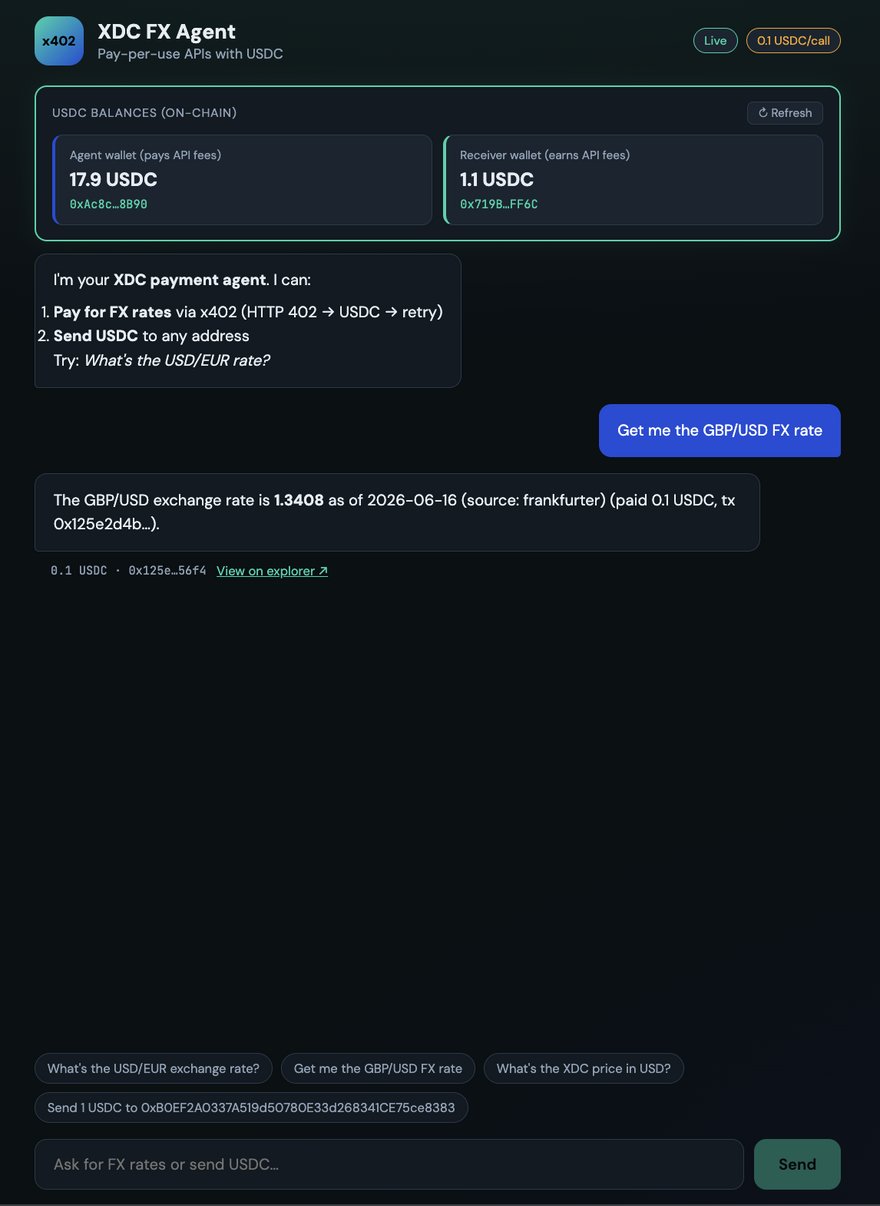
How It Works
Step 1 — User Input
Get me the GBP/USD FX rate
Step 2 — Agent Calls API
GET /fx/GBP-USD
Server returns HTTP 402:
{
  "x402Version": 1,
  "accepts": [{
    "scheme": "exact",
    "network": "eip155:51",
    "maxAmountRequired": "100000",
    "payTo": "0x719B...",
    "asset": "0xb5AB69..."
  }]
}
Step 3 — Agent Pays USDC on XDC
Agent sends 0.1 USDC to the API receiver wallet.
Step 4 — Agent Retries with Proof
Same request, with X-PAYMENT header containing the transaction hash.
Step 5 — User Gets the Answer
The GBP/USD exchange rate is 1.27
0.1 USDC paid → View on testnet.xdcscan.com
### Simple Flow
You    →  "What's the USD/EUR rate?"
Agent  →  calls FX API
API    →  HTTP 402 (pay 0.1 USDC)
Agent  →  pays USDC on XDC
Agent  →  retries with proof
API    →  returns FX data
You    →  gets rate + explorer link
Conclusion
This project shows they can also pay websites and APIs — via x402, USDC, and the same agent loop.
- 1. User expresses intent in natural language
- 2. Agent understands and routes the request
- 3. x402 handles pay-per-use API access
- 4. USDC settles on XDC Network
- 5. User gets data and an explorer link — no signup required





Discussion (1)
Incredible work! The idea of 'No account. No API key. Just pay-per-call' is exactly where the future of AI and Web3 integration is heading. Thanks for sharing this detailed breakdown of x402 micropayments on XDC!