

Introduction
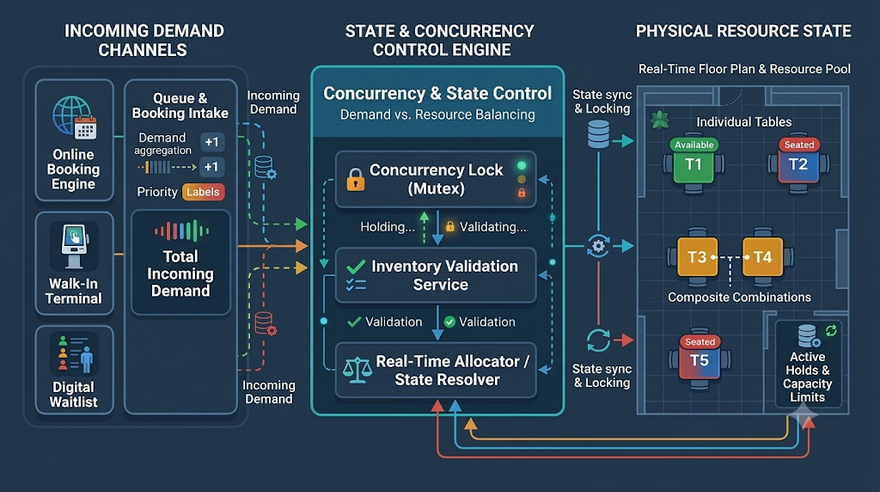
Managing a busy dining room using paper floor charts and phone ledgers quickly introduces operational bottlenecks. When hosts attempt to track incoming phone requests, handle sudden cancellations, and coordinate walk-in parties at the front door simultaneously, human error inevitably leads to double bookings, delayed seatings, and underutilized tables. Modern hospitality engineering approaches this friction as a dynamic resource-allocation problem, coordinating physical seating with real-time digital schedules.
Synchronizing Booking Channels and Floor Inventory
A dining room is governed by physical constraints: fixed table dimensions, service shifts, and turn times. An effective Online Restaurant Booking System acts as a state coordinator, ensuring reservation slots correspond to actual table configurations rather than arbitrary calendar entries.
Deploying modern Restaurant Table Management Software helps host teams manage table combinations, assign capacity limits, and enforce seating buffers between shifts. Paired with interactive Restaurant Floor Plan Software, staff can visualize the physical layout of the dining room in real time. This spatial tracking ensures that assigning a four-top table to a party does not conflict with contiguous tables scheduled for larger parties later in the service.
For venues looking to establish an unmediated booking channel, setting up a Direct Restaurant Booking System on the venue's own digital assets allows guests to select dates, receive automated confirmation codes, and manage modifications through self-service links. This direct interaction reduces telephone interruptions while maintaining accurate guest records.
Balancing Unplanned Foot Traffic with Pre-Booked Guests
A fully booked reservation ledger does not mean table seating stops entirely. Dynamic variables—such as parties finishing early, late arrivals, or last-minute cancellations—mean table turnover requires continuous adjustments.
Integrating dedicated Restaurant Waitlist Management Software allows venues to log overflow demand during peak hours, providing guests with estimated wait windows derived from current dining durations. At the entrance, Restaurant Walk-In Management Software ensures that unannounced arrivals are logged immediately into the primary system, preventing front-of-house staff from assigning an empty table that has already been reserved for an upcoming online booking.
Centralizing these streams via dedicated Restaurant Host Stand Software gives front-of-house staff a unified, low-latency interface showing upcoming arrivals, currently seated tables, and open capacity across service windows.
Practical Front-of-House Workflows with DineGlobe
For operators evaluating technical solutions, choosing specialized Restaurant Reservation Software for Small Restaurants provides essential table coordination without the overhead of complex, legacy enterprise installations.
This unified operational approach is the core focus of DineGlobe. Built as a comprehensive Restaurant Reservation Software platform, DineGlobe coordinates direct booking pages, table allocations, visual floor plans, waitlist tracking, and walk-in guest management. The platform also includes guest self-service links, role-based staff access, operational reporting, and multilingual interfaces in English, Japanese, and Arabic.
To help independent venues explore these tools, DineGlobe offers a Free Restaurant Reservation System during its initial pilot phase, giving hospitality teams direct access to its core booking and front-of-house capabilities.
Conclusion
Organizing a restaurant's front of house requires viewing reservations, table capacity, waitlists, and walk-ins as a single, connected workflow. When software synchronizes real-world floor availability with guest-facing booking channels, hospitality teams spend less time fixing administrative mix-ups and more time focusing on guest service. Platforms like DineGlobe demonstrate how unified operational tools can bring clarity to high-volume dining operations.





Discussion (0)