
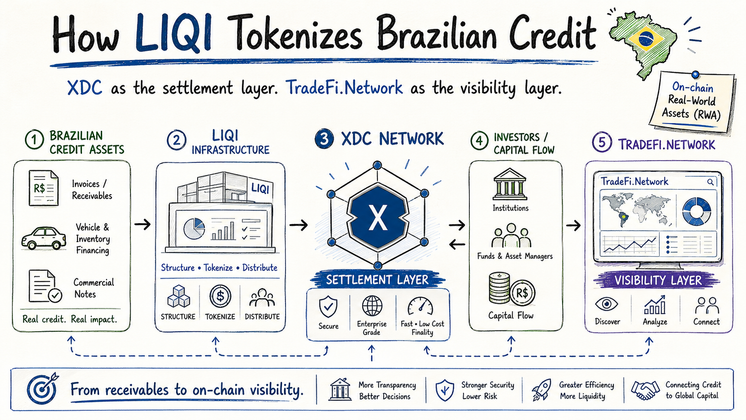

From Brazilian credit assets to on-chain visibility: LIQI, XDC, and TradeFi.Network
How LIQI Digital Assets Built the Infrastructure That Makes Brazilian Credit Flow and Why XDC Network Is the Settlement Layer Underneath It All
Brazil is becoming one of the more interesting markets to watch in tokenized credit. Not because “tokenization” sounds modern. But because some players are actually rebuilding the infrastructure underneath working capital, receivables, and credit distribution in a way that looks operationally meaningful.
One of the clearest examples is LIQI Digital Assets.
A useful way to understand LIQI is to start with a real transaction
Kavak , one of Latin America’s largest used-car marketplaces, needed working capital for its Brazilian operations. It had assets: car inventory, trade receivables, and commercial notes. What it did not have was a fast and efficient path to the investors willing to fund them.
Under a more traditional route, this kind of financing would typically involve multiple layers: fund setup, regulatory filing, custody, distribution delays, and the administrative overhead that comes with each of them.
In that specific operation, Daniel Coquieri, CEO of LIQI, confirmed the transaction delivered 60% lower infrastructure costs versus the traditional approach, while also enabling smaller ticket sizes and broader investor access.
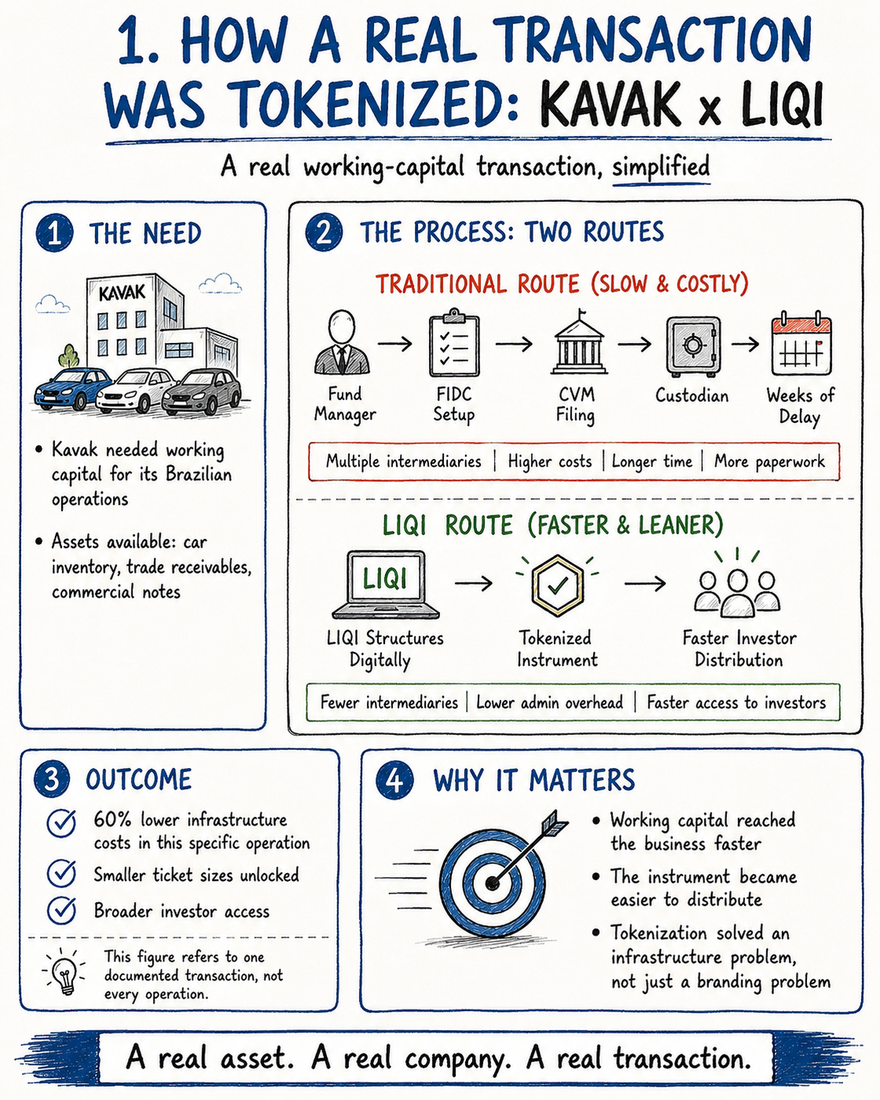
How a real Brazilian credit transaction was tokenized through LIQI
LIQI is not best understood as a fund manager. And it is not best understood as a bank. It is better understood as infrastructure between originators and capital.
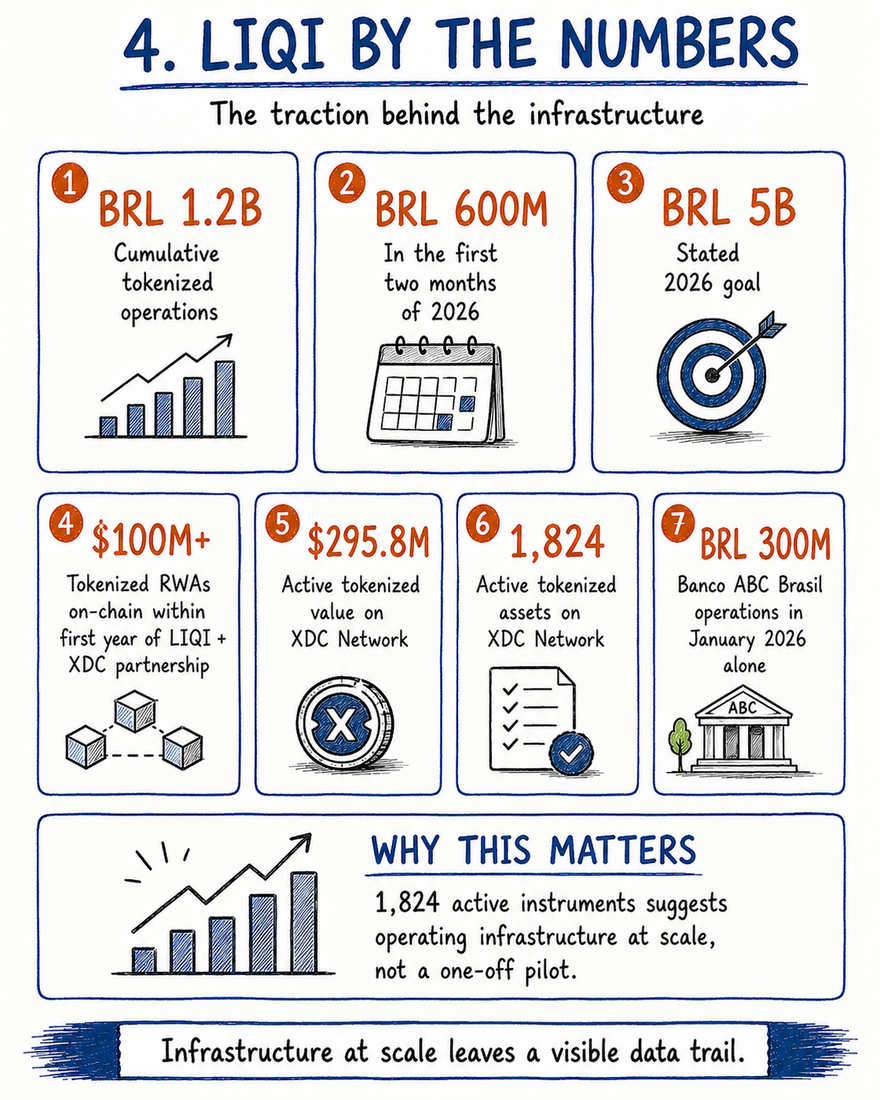
Founded in São Paulo in 2021, LIQI has positioned itself around improving efficiency in capital market processes. By early 2026, LIQI had reached BRL 1.2 billion in cumulative tokenized operations, including BRL 600 million in the first two months of 2026 alone, with a stated goal of exceeding BRL 5 billion across the year. Those numbers matter, but even more important is what they suggest: this is no longer just an experiment in issuing one tokenized asset. It is an infrastructure stack being used repeatedly in live credit workflows.
What makes the LIQI story more compelling is that the buildout happened in layers.
First came TIDC (Tokenized Investment in Credit Rights), described as an automated securitization and settlement protocol. Then came the first tokenized receivables certificate with Kavak. Then Brazil’s first FIDC (Credit Rights Investment Fund) investing in tokenized securities. Then the introduction of Liqi Securitizadora, giving the company a licensed in-house issuance stack across multiple instruments such as CRs, CRIs, CRAs, and debentures.
Seen together, these milestones tell a more important story than a single transaction could. By the time LIQI partnered with XDC Network in 2025, it was not just “starting tokenization.” It was scaling a machine that had already been built and tested through successive infrastructure layers.
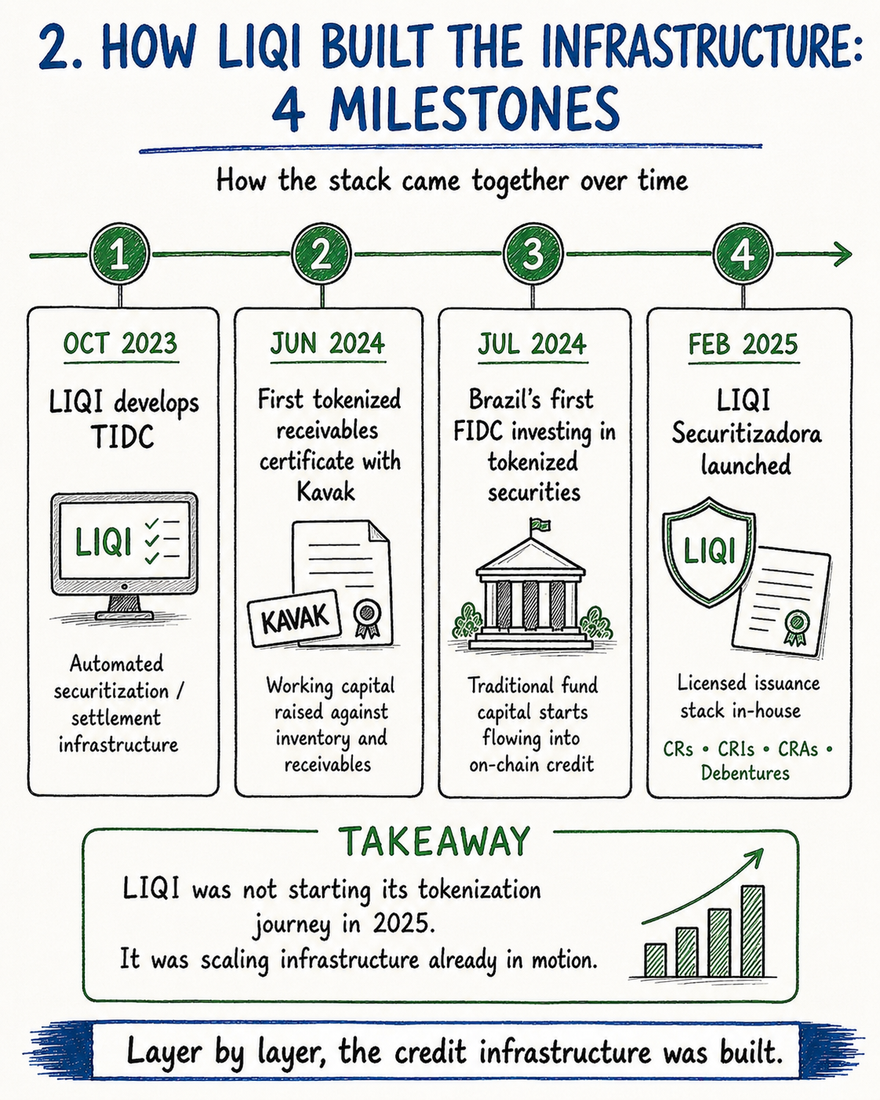
How LIQI built its credit tokenization stack, milestone by milestone
The business problem underneath this is straightforward. A company can complete a sale, ship goods, and raise an invoice, yet still wait weeks for cash to arrive. Traditional structures such as FIDCs help bridge that gap, but they also bring friction: setup time, fund size thresholds, manual reconciliation, and limited visibility outside the immediate deal structure.
LIQI’s TIDC model is interesting because it appears to reduce that operational drag without removing the regulated framework underneath the issuance. What makes the model more interesting is that the compliance framework remains, while the repetitive administrative layer around it becomes more automated. That is a much more serious institutional proposition than simply saying an asset was “put on-chain.”
From a market-structure point of view, the capital flow is where the story becomes much more relevant. A company brings receivables or other debt assets. LIQI structures the instrument under Brazilian securities law. The instrument is issued digitally on XDC Network. Investors subscribe. From there, payments, reporting, compliance checkpoints, and lifecycle events can be tracked with more automation and more consistency.
This is where XDC’s role becomes important
The value of XDC in this flow is not abstract. It is practical: low-cost settlement, fast finality, on-chain auditability, and alignment with frameworks like ISO 20022 and MLETR. That makes it much more relevant to institutional credit and trade-finance infrastructure than a generic blockchain narrative. In this stack, XDC is not the headline for its own sake. It is the settlement layer that allows the workflow to run more efficiently.
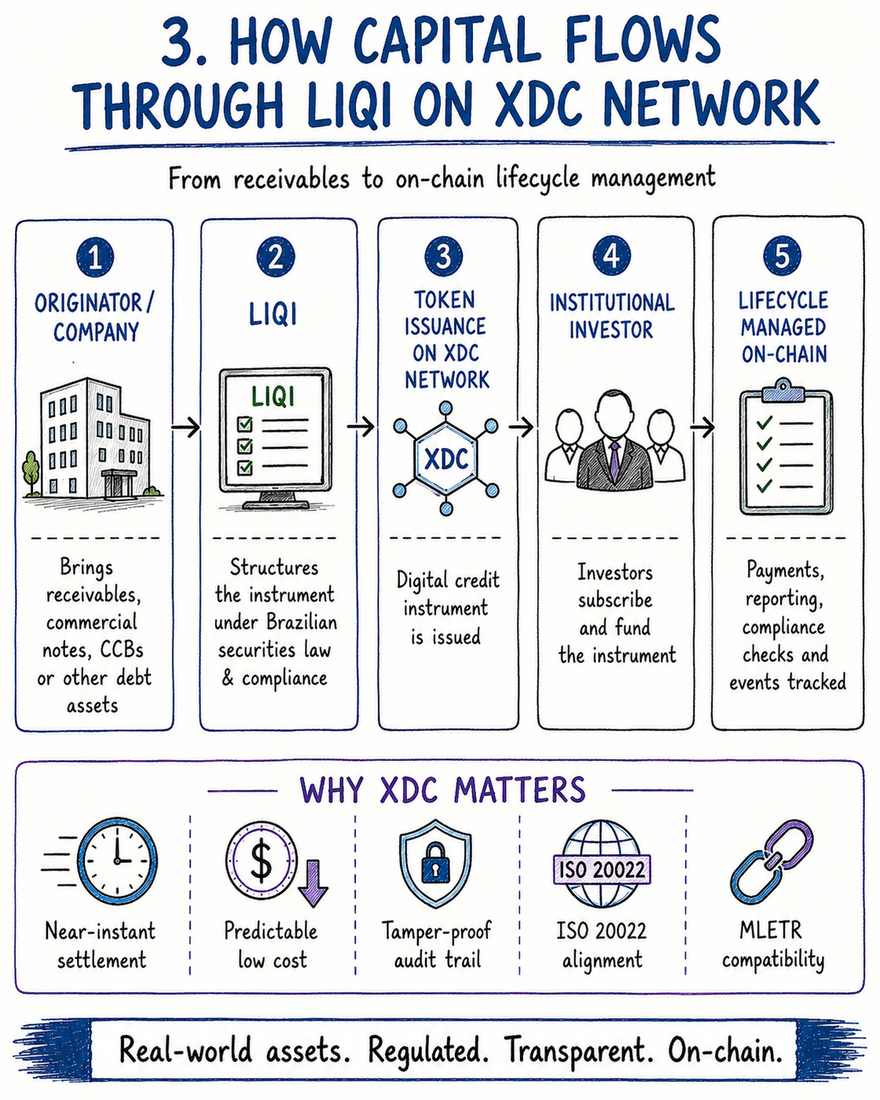
The end-to-end capital flow of tokenized credit on XDC Network
What TradeFi.Network Makes Visible on XDC
What matters most here is not only that LIQI is issuing tokenized credit. What matters is that this activity is becoming visible, structured, and discoverable on XDC Network.
That is where TradeFi.Network becomes important.
LIQI shows what real-world tokenization infrastructure can look like in practice: regulated credit instruments, institutional workflows, and on-chain lifecycle management. XDC provides the settlement layer that makes this possible. But without a visibility layer, much of that activity would still remain buried inside issuer announcements, isolated APIs, and fragmented deal updates.
TradeFi.Network helps bridge that gap.
It acts as a data and discovery layer for real-world asset activity on XDC, making issuer activity more legible to investors, institutions, builders, and ecosystem participants. Instead of only hearing that tokenization is happening, users can begin to see it in a more structured way: which issuers are active, what types of assets are live, how value is distributed, and how the ecosystem is evolving over time.
LIQI Brazil alone currently shows $295.8 million in tokenized value across 1,824 individual active assets on TradeFi.Network, sourced directly via LIQI’s API. That number is not a fund size. It is the output of automated settlement infrastructure running at scale.
That is an important shift. For tokenized private markets to attract broader institutional attention, issuance alone is not enough. Markets also need discoverability, comparability, and transparency. That is the role TradeFi.Network is designed to play for XDC’s RWA ecosystem.
In that sense, LIQI is not just the company being profiled here. It is also an example of a broader point: real credit activity is happening on XDC, and TradeFi.Network is helping make that activity visible.
What TradeFi.Network makes visible on XDC
That is why I think this is ultimately a working-capital story first and a blockchain story second.
The real signal is not that tokenization exists. The real signal is that a regulated credit workflow is being rebuilt in a way that can reduce friction, improve operational efficiency, and make asset activity more legible to the market.
LIQI is important because it provides a live example of that. XDC is important because it provides the settlement infrastructure underneath it. TradeFi.Network is important because it provides the visibility layer that helps the market actually understand what is happening on-chain.
That combination is far more interesting than a standalone tokenization announcement.
And it points to something bigger: as more issuers, asset classes, and structured credit flows come on-chain, the value of the ecosystem will increasingly depend not only on who can issue, but also on who can make that activity visible, discoverable, and understandable.
That is where I think the next phase of on-chain real-world assets becomes much more compelling.
LIQI is one example, not the whole story. There is more being built across XDC, and more tokenized structures worth examining closely.
Sources
[1] Bitcoin.com News / Oliveira Trust RI — Kavak × LIQI: 60% infrastructure cost savings for that specific operation, smaller ticket sizes, commercial notes structure, and Oliveira Trust as guarantor agent.
- Bitcoin.com News: Mexican Startup Kavak Issues Tokenized Debt to Invest in Brazil’s Used Car Business
- Oliveira Trust RI: A Liqi quer levar o blockchain ao mercado-financeiro
[2] LIQI official website / company materials — Company timeline and product positioning, including Apr 2021 company background, Oct 2023 TIDC, Jun 2024 Kavak, Jul 2024 first FIDC investing in tokenized securities, and Feb 2025 Liqi Securitizadora context.
[3] LIQI press releases / company updates — BRL 1.2B cumulative operations, BRL 600M in the first two months of 2026, BRL 5B stated 2026 goal, Banco ABC Brasil BRL 300M TIDC deal, and Liqi Securitizadora / CVM S2 registration context.
[4] XDC Network official materials — XDC settlement characteristics, enterprise positioning, ISO 20022 context, and MLETR-related positioning for the LIQI use case.
[5] TradeFi.Network — Live RWA dashboard on XDC Network; LIQI Brazil issuer data sourced via LIQI API integration.




Discussion (0)